Internal Family Systems
Educational Resource

Internal Family Systems
A transformative, evidence-based approach that helps clients access their core Self to heal wounded parts and restore internal harmony. IFS recognizes that there are no "bad" parts ~ only parts carrying burdens they long to release.
Developed by Richard C. Schwartz, PhD (1980s-present)

CEUs are being negotiated. Post-tests, certificates, and CE credit are not currently available.
Internal Family Systems (IFS): An Introduction for Clinicians
Target Audience: Licensed mental health professionals (psychologists, clinical social workers, licensed professional counselors, marriage and family therapists)
Internal Family Systems (IFS) is a non-pathologizing, evidence-based psychotherapy developed by Dr. Richard Schwartz that combines systems thinking with the concept of multiplicity of the mind. The model posits that the mind is naturally composed of various "parts" or subpersonalities, each with its own unique perspective and qualities. At the core of every individual is a Self, characterized by qualities such as compassion, curiosity, and confidence. The theoretical foundation of IFS rests on the belief that there are no "bad" parts; every part has a positive intention and holds valuable qualities. The goal of IFS is not to eliminate parts but to heal and harmonize the inner system, allowing the Self to lead.
The clinical application of IFS is particularly effective for trauma treatment. It provides a unique framework for understanding and working with the inner worlds of clients who have experienced trauma. Traumatized parts, known as "exiles," hold the pain and memories of traumatic events. They are protected by "managers," who strive to maintain control and prevent the exiles from being triggered, and "firefighters," who emerge to distract from or numb the pain of exiles when they do get activated. IFS therapy helps clients access their Self-energy to connect with and heal these parts, fostering internal harmony and resilience. This Self-led approach empowers clients to become their own inner healers, which is a profound departure from many traditional therapeutic models.
A growing body of research supports the efficacy of Internal Family Systems therapy, particularly for the treatment of PTSD and complex trauma. This module will deepen the clinician's understanding of the IFS model by providing a comprehensive overview of its core concepts and techniques. Participants will learn to identify and work with parts, cultivate Self-energy in themselves and their clients, and apply the IFS protocol to facilitate healing and integration. By the end of this course, clinicians will be equipped with the foundational knowledge and skills to begin incorporating IFS into their clinical practice, enhancing their ability to work effectively with clients presenting with a wide range of psychological issues, including the profound effects of trauma.
Upon completion of this module, the learner will be able to:
- 1Describe the theoretical foundations of the Internal Family Systems (IFS) model, including the concepts of parts and the Self.
- 2Differentiate between the three primary types of parts in IFS: exiles, managers, and firefighters.
- 3Identify the 8 C's and 5 P's of Self-energy and their role in fostering a therapeutic presence.
- 4Apply the 6 F's Protocol (Find, Focus, Flesh out, Feel toward, beFriend, Fear) to a clinical case example.
- 5Analyze the process of unburdening and its application in treating complex trauma with multiple exile systems.
CEUs are being negotiated. Post-tests, certificates, and CE credit are not currently available. The course overview and learning objectives are available now for educational use. Planned contact hours for this module: 2.5.
Featured Video
Linda Curran interviews IFS developer Dick Schwartz, with a demonstration of the Internal Family Systems approach.
What is Internal Family Systems?
Internal Family Systems (IFS) is an integrative approach to individual psychotherapy developed by Richard C. Schwartz in the 1980s. It combines systems thinking with the view that the mind is made up of relatively discrete subpersonalities, each with its own viewpoint and qualities.
"The goal of IFS is not to eliminate parts but to help them find their non-extreme roles. There are no 'bad' parts ~ only parts carrying burdens they would gladly release if given the chance."
~ Richard C. Schwartz, PhD
Basic Assumptions of IFS
Multiplicity of Mind
The mind naturally subdivides into multiple parts or subpersonalities
Everyone Has a Self
Everyone has a core Self that can and should lead the internal system
No Bad Parts
All parts have positive intentions; the goal is to help them find non-extreme roles
Systems Thinking
Parts form a complex system; when reorganized, parts can change rapidly
See also: Window of Tolerance - a foundational concept across all trauma modalities.
The Self and Parts
The Self is the core, undamaged essence of a person ~ different from parts. When differentiated, the Self is competent, secure, relaxed, and able to listen and respond with wisdom.
- Naturally curious and compassionate
- Cannot be damaged by trauma
- Can lead the internal system
- Present in everyone
Parts are subpersonalities that develop to help us navigate life. They interact internally in patterns similar to how people interact in families or systems.
- All have positive intentions
- Can carry burdens from trauma
- May take on extreme roles
- Can transform when unburdened
Blending vs. Unblending
Blending occurs when a part's feelings overwhelm the Self, causing the person to lose perspective. Unblending is the process of creating enough separation for the Self to observe the part with curiosity rather than being taken over by it. This is a key skill in IFS work.
The Three Types of Parts
IFS identifies three general categories of parts based on their roles in the internal system. Understanding these categories helps therapists and clients navigate the internal landscape.
- Carry burdens from past experiences
- Often feel young, vulnerable, or wounded
- May feel abandoned, worthless, or terrified
- Desperately want to be seen and healed
- Can flood the system if triggered
- Strive for perfection and control
- Plan, organize, and anticipate problems
- May be critical, judgmental, or people-pleasing
- Work hard to keep the person functional
- Fear what will happen if exiles emerge
- React impulsively when pain surfaces
- May use substances, food, or self-harm
- Can be aggressive or dissociative
- Don't care about consequences
- Share the same goal as managers: protect from exile pain
Protectors
Both Managers and Firefighters are Protectors ~ they share the same goal of keeping exiles' pain from overwhelming the system. They differ in strategy: Managers work proactively to prevent activation, while Firefighters react after exiles are triggered.
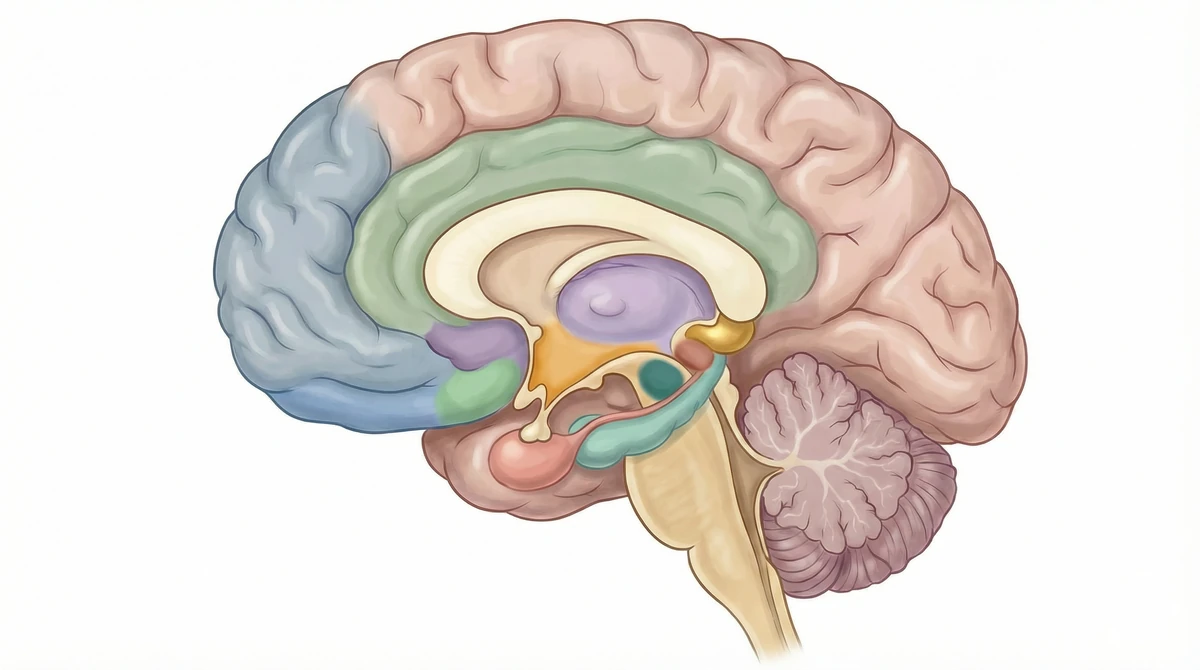
Neuroscience
Understanding the brain regions engaged by IFS helps clinicians appreciate why this approach is effective at the neurobiological level.
Brain Regions Engaged by IFS
Click on any brain region to explore how Internal Family Systems therapy engages it.
Keep this guide free.
IFS Treatment Methods
Non-Imaging Techniques
These techniques don't require visualization and can be used with clients who have difficulty with imagery.
Assessing Internal Dialogue
Listening to and exploring the internal conversations between parts, helping clients become aware of how parts communicate and interact.
Using the IFS Language
Introducing and consistently using IFS terminology (parts, Self, protectors, exiles) to help clients develop a new relationship with their internal experience.
Body Location
Asking clients to locate where they feel a part in or around their body, using somatic awareness as an entry point to parts work.
Diagrams
Creating visual representations of the internal system, mapping parts and their relationships to help clients understand their internal landscape.
Journaling
Having clients write dialogues between Self and parts, or between parts, to deepen understanding and facilitate communication.
Direct Access
The therapist speaks directly to a part, or facilitates direct communication between Self and parts, or between parts themselves.
Imaging Techniques
These techniques use visualization and imagery to facilitate deeper parts work and healing.
Room Technique
Inviting the client to visualize a room where they can meet with parts, providing a safe internal space for dialogue and healing.
Mountain or Path Exercise
Guiding the client on an imaginary journey up a mountain or along a path, encountering parts along the way.
Going Back in Time
Having the Self travel back to be with an exile at the time of the original wounding, bringing compassion and understanding.
Retrieval
Bringing an exiled part from the past into the present, helping it realize the traumatic situation is over and it can now be cared for by the Self.
Future Imaging
Helping parts envision a positive future after healing, imagining what life could be like without their burdens.
Working with Multiple Parts
Facilitating meetings between multiple parts, helping them understand each other and resolve conflicts.
Confronting Significant Others
Having the Self or parts confront (in imagery) people who caused harm, expressing what couldn't be said at the time.
Healing Place
Creating an internal sanctuary where parts can rest, heal, and feel safe after unburdening.
Use of Light
Using imagery of light to release burdens, heal wounds, or bring Self-energy to parts that need it.
Therapist Self-Care
Working with trauma can activate the therapist's own parts. Recognizing these signs and attending to your own internal system is essential for effective and sustainable practice.
Feeling protective of a client in ways that mirror their protectors
Your own protector parts may be activated. Consider what in the client's story resonates with your own history.
Experiencing similar emotions to the client's exiles
You may be blending with your own exiles. Take time to unblend and return to Self before continuing.
Adopting the client's defenses
Notice if you're avoiding certain topics or feelings. Your parts may be protecting you from activation.
Feeling stuck in the same way the client feels stuck
Parallel process may be occurring. Seek consultation or your own IFS work to address this.
Boundary confusion
Parts of you may be taking on responsibility for the client's healing. Return to Self-leadership.
Activation of your own similar parts
This is normal and can be useful information. Acknowledge your parts and return to Self.
Self-Care Recommendations
IFS with Complex Trauma
Working with complex trauma and structural dissociation requires specific adaptations to the standard IFS approach. These modifications help ensure safety and effectiveness.
- Extended stabilization phase before exile work
- More emphasis on protector work and building internal trust
- Slower pacing with frequent grounding
- Integration of structural dissociation framework
- Attention to window of tolerance and titration
- Building internal communication before processing
- Client becomes overwhelmed or dissociates frequently
- Protectors become more extreme rather than relaxing
- Client reports worsening symptoms between sessions
- Difficulty maintaining dual awareness
- Parts switching without Self-leadership
- Inability to stay grounded in present
Structural Dissociation Integration
When working with clients who have structural dissociation, IFS concepts can be integrated with the ANP (Apparently Normal Part) and EP (Emotional Part) framework:
ANP-Protectors
Manager parts that help maintain daily functioning and keep traumatic material at bay.
EP-Exiles
Parts that hold traumatic memories and emotions, often frozen in time at the age of trauma.
Complementary Approaches
IFS integrates well with other trauma modalities. Each approach offers unique contributions to complex trauma work:
Deep Brain Reorienting
Brainstem-level processing and orienting tension
EMDR
Bilateral stimulation and adaptive information processing
Sensorimotor
Body-based processing and movement
Gestalt
Relational presence and dialogue
Somatic Experiencing
Titration and nervous system regulation
Neurofeedback
Brain wave training for regulation
Complex Trauma Comparison Chart
A comprehensive guide comparing when to use each modality's specific complex trauma modifications. Includes clinical decision trees, sequencing considerations, and at-a-glance comparison tables.
Session Language
Clinical prompts and phrases for IFS therapy sessions
Contraindications & Cautions
While IFS is generally safe and effective, certain situations require caution, adaptation, or referral. Understanding these helps ensure appropriate treatment planning.
Glossary of IFS Terms
Academic Resources
IFS Quick Reference Card
A comprehensive 6-page PDF with core concepts, the 8 C's & 5 P's, the 6 F's protocol, unblending techniques, working with protectors and exiles, unburdening ritual, session language examples, contraindications, and quick-reference tables.
Foundational Texts
Research & Evidence
Internal Family Systems (IFS) Therapy for PTSD among Survivors of Multiple Childhood Trauma: A Pilot Effectiveness Study
Hodgdon, H.B., Anderson, F.G., Southwell, E., Hrubec, W., & Schwartz, R. • (2022)
Pilot study showing significant PTSD symptom reduction with IFS therapy
Full Text PDFA Randomized Controlled Trial of an IFS-based Psychotherapeutic Intervention on Outcomes in Rheumatoid Arthritis
Shadick, N.A., Sowell, N.F., Frits, M.L., et al. • (2013)
RCT showing IFS reduced pain and depression in RA patients
Full Text PDFThe Efficacy of IFS Therapy in the Treatment of Depression Among Female College Students: A Pilot Study
Haddock, S.A., Weiler, L.M., Trump, L.J., & Henry, K.L. • (2017)
Pilot RCT showing IFS effectiveness for depressive symptoms
Full Text PDFTraining & Certification
Official IFS Resources
For training opportunities, certification, and the latest research, visit the official IFS Institute website maintained by Dr. Richard Schwartz.
Visit IFS Institute