Sensorimotor Psychotherapy
Because Words Are Not Enough

Sensorimotor Psychotherapy
A body-centered approach to healing trauma that integrates neuroscience, psychology, and embodied awareness. Because trauma first affects the body, the body itself holds the key to healing.
Developed by Dr. Pat Ogden

CEUs are being negotiated. Post-tests, certificates, and CE credit are not currently available.
Sensorimotor Psychotherapy for Trauma Treatment
Target Audience: Licensed mental health professionals (psychologists, clinical social workers, licensed professional counselors, marriage and family therapists)
Sensorimotor Psychotherapy, developed by Pat Ogden, PhD, is a body-centered approach to psychotherapy that addresses the somatic, emotional, and cognitive effects of trauma. It is founded on the principle that the body holds and expresses the legacy of traumatic experiences. The theoretical framework integrates principles from neuroscience, attachment theory, and cognitive approaches, emphasizing a three-phase treatment model: stabilization and safety, processing of traumatic memory, and integration. This modality uniquely addresses the hierarchy of information processing, recognizing that sensorimotor-level experiences often need to be addressed before emotional and cognitive processing can be effective.
What distinguishes Sensorimotor Psychotherapy in the treatment of trauma is its direct engagement with the body's innate intelligence. Clinicians learn to help clients develop somatic resources, such as grounding and centering, to regulate the nervous system and stay within their 'window of tolerance.' The approach utilizes body-based interventions to help clients track their somatic experience, practice mindful body awareness, and complete truncated defensive movements that were thwarted during the traumatic event. This focus on procedural memory and the physical patterns of trauma responses offers a powerful pathway to healing that traditional talk therapies may not access, particularly for clients with complex trauma who may experience a 'phobia of the body.'
The evidence base for body-centered therapies in trauma treatment is growing, highlighting the importance of addressing the physiological dysregulation that accompanies traumatic stress. This module will provide clinicians with a comprehensive understanding of the principles and techniques of Sensorimotor Psychotherapy. By learning to work with the body as a source of information and a resource for healing, therapists can deepen their clinical practice and more effectively guide clients toward resolution and integration of their traumatic experiences. This training will equip professionals to apply these powerful, body-based interventions in a safe and effective manner.
Upon completion of this module, the learner will be able to:
- 1Describe the theoretical foundations of Sensorimotor Psychotherapy, including the hierarchy of information processing.
- 2Explain the three-phase treatment model (stabilization, processing, integration) and its clinical application.
- 3Identify key somatic resources and body-based interventions used to regulate the nervous system.
- 4Differentiate between top-down (cognitive) and bottom-up (sensorimotor) processing in trauma therapy.
- 5Apply the concept of the window of tolerance to assess and manage client arousal states during treatment.
CEUs are being negotiated. Post-tests, certificates, and CE credit are not currently available. The course overview and learning objectives are available now for educational use. Planned contact hours for this module: 1.5.
Featured Video
An interview with Dr. Janina Fisher on Sensorimotor Psychotherapy and its application to trauma treatment.
What is Sensorimotor Psychotherapy?
Sensorimotor Psychotherapy stands at the intersection of neuroscience, psychology, and embodied healing. Because trauma first and foremost affects the body, the body itself holds the key to healing from the debilitating effects of traumatic experiences.
This therapeutic approach places an emphasis on the body as a reservoir of information, a target for intervention, and a catalyst for transformative change.
The Triune Brain Framework
To understand Sensorimotor Psychotherapy, one must first grasp the triune brain metaphor (MacLean, 1985), which divides the human brain into three components:
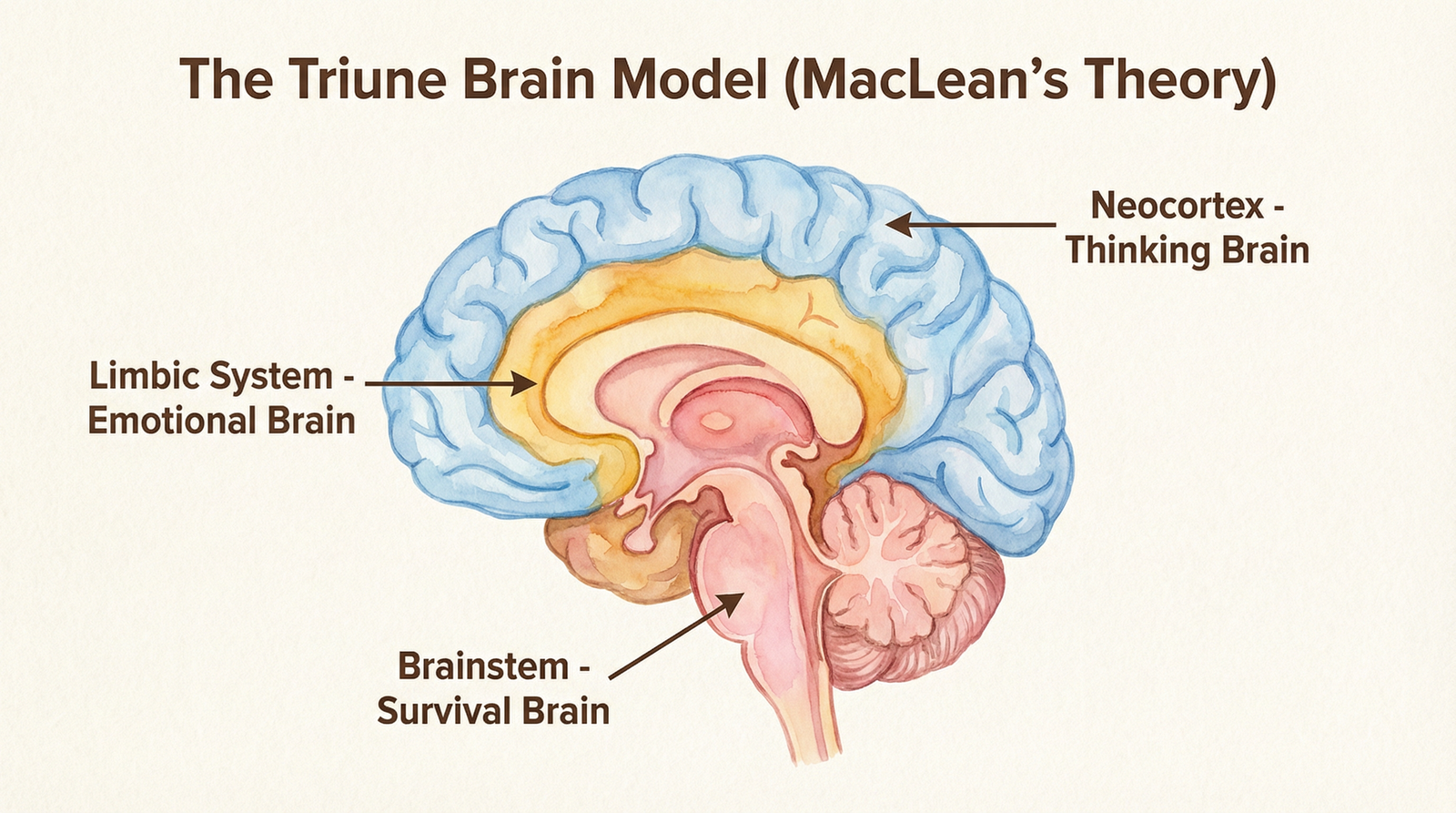
Brainstem - Survival Brain
Housing survival instincts: cry-for-help, fight, flight, freeze, shut down
Limbic System - Emotional Brain
The seat of subjective emotions and relational bonding
Neocortex - Thinking Brain
Responsible for declarative knowledge, thought, and meaning-making
While traditional psychotherapy often relies on insight and cognitive meaning-making (neocortex), Sensorimotor Psychotherapy uniquely integrates bottom-up interventions that target autonomic nervous system arousal and instinctive defensive movements rooted in the reptilian brain. These deeply ingrained neurobiological patterns may be impervious to traditional "top-down" resolution based on thinking and insight alone.
Core Concepts
See also: Window of Tolerance - a foundational concept across all trauma modalities.
The foundational principles that guide Sensorimotor Psychotherapy practice. Click each card to explore clinical applications.
Targeting the body's autonomic nervous system and instinctive defensive movements rooted in the reptilian brain, rather than relying solely on cognitive insight.
Physical actions that modulate arousal ~ aligning the spine, grounding through the legs, regulated breathing ~ becoming tools for clients to manage dysregulation.
The optimal zone of arousal where a person can function effectively ~ between hyperarousal (anxiety, panic) and hypoarousal (numbness, shutdown).
Instinctive impulses to defend and protect ~ striking out, pushing away, fleeing ~ that were abandoned during trauma but remain encoded in the body.
Helping clients who perceive their body as a source of repulsion or betrayal to gradually befriend and appreciate their physical self.
Understanding how trauma creates 'parts of self'~ one fixated in defense, another attempting daily life ~ and using the body to help these parts integrate.
Neuroscience
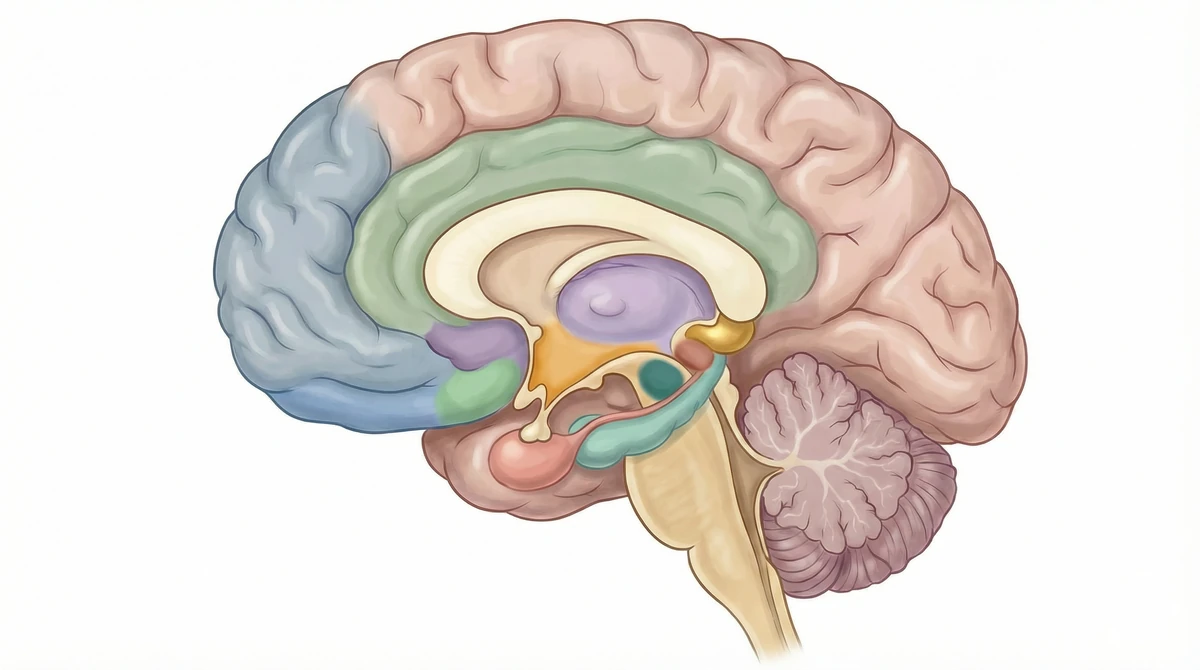
Understanding the brain regions engaged by Sensorimotor Psychotherapy helps clinicians appreciate Ogden's three-level model of processing.
Brain Regions Engaged by Sensorimotor Psychotherapy
Click on any brain region to explore Ogden's three-level model of processing.
Keep this guide free.
Ogden's Hierarchy of Information Processing
Pat Ogden's foundational insight: experience organizes itself across three levels of processing ~ sensorimotor, emotional, and cognitive. These levels form a hierarchy, and the direction of processing matters.
Most talk therapies work top-down ~ from cognition toward emotion and body. Sensorimotor Psychotherapy works bottom-up ~ starting with the body's sensations and movements, allowing emotion and meaning to emerge organically. This is not anti-cognitive; it's a recognition that the body holds information that cognition alone cannot access.
Cognitive
Thoughts, beliefs, narratives, meaning-making, interpretations
Where most talk therapy operates. Includes schemas, attributions, and the stories clients tell about their experience. Important but insufficient alone for trauma.
Emotional
Feelings, affects, moods, emotional memories, relational patterns
The bridge between body and mind. Emotions have both cognitive components (appraisal) and somatic components (felt sense). Trauma often disrupts this bridge.
Sensorimotor
Body sensations, posture, movement, gesture, autonomic arousal, five senses
The foundation. Where trauma is stored as procedural memory ~ habitual movement patterns, chronic tension, postural collapse, defensive responses that never completed. SP starts here.
Why Bottom-Up Matters for Trauma
Trauma lives in the body as procedural memory ~ automatic patterns of bracing, collapsing, freezing, or fleeing that were adaptive during the traumatic event but persist long after the danger has passed. These patterns operate below the level of conscious awareness and cannot be changed through insight alone.
Sensorimotor Psychotherapy accesses these patterns directly through the body: tracking sensation, following impulses to move, completing defensive responses that were thwarted. As the body reorganizes, emotion and meaning shift spontaneously ~ without the therapist needing to interpret or explain.
"The body has been largely left out of the 'talking cure.' Yet the body is the very place where traumatic experience is encoded and where the effects of trauma are most palpably felt."
~ Pat Ogden, Kekuni Minton & Clare Pain, Trauma and the Body (2006)
Somatic Resources
In Sensorimotor Psychotherapy, somatic resources are body-based capacities that help clients regulate arousal and maintain the window of tolerance. Unlike cognitive coping strategies ("think of a safe place"), somatic resources are anchored in the body's actual experience ~ they work because the nervous system recognizes them as real.
Grounding
Feeling the contact between body and support surfaces ~ feet on floor, back against chair. Not imagined; tracked as actual sensation.
Centering
Awareness of the body's core ~ the vertical axis from crown to pelvic floor. Helps clients find stability when emotionally activated.
Boundary Awareness
Sensing the skin as a container, the space between self and other. Particularly important for clients whose boundaries were violated.
Alignment & Posture
Tracking habitual postural patterns ~ collapse, bracing, leaning away ~ and experimenting with small shifts toward more supported alignment.
Breath as Resource
Not prescribed breathing exercises, but tracking the client's natural breath pattern and noticing what happens when breath is allowed to deepen on its own.
Orienting
Slowly looking around the room, taking in the environment through the senses. Engages the social engagement system and signals safety to the nervous system.
Clinical Distinction: Somatic Resources vs. Coping Skills
Coping skills are cognitive strategies applied to the body ("take three deep breaths"). Somatic resources emerge from the body ~ they are discovered through mindful attention to what is already happening. The therapist's job is not to prescribe resources but to help the client notice the ones that are already present: "Your feet are on the floor right now. What do you notice about that contact?" This distinction matters because trauma survivors have often been told what to do with their bodies. SP invites them to listen to their bodies instead.

Three-Phase Treatment Model
Sensorimotor Psychotherapy adopts a phase-oriented approach that is fluid rather than rigid, adapting to the evolving needs of each client.
Three-phase model with six core techniques for body-oriented trauma processing
Treatment Phases
Phase 1: Stabilization
Regulation of arousal, behavior, and emotion
The first task is to stabilize dysregulated arousal. Clients learn to recognize bodily signs of dysregulation and develop somatic resources to modulate arousal and expand the window of tolerance.
Phase 2: Processing
Reprocessing traumatic memory
Once stabilized, clients can safely approach traumatic material. This phase involves completing or regulating instinctive defensive responses that were thwarted during the original trauma.
Phase 3: Integration
Relational and life success
The final phase addresses relational effects of attachment failures, proximity-seeking actions, and movements that support overall success in life and relationships.
Core Techniques
Mindful Body Awareness
Foundation for all interventions
Guiding clients to notice bodily sensations, postures, and movements without judgment ~ the foundation for all other Sensorimotor interventions.
Tracking
Following the body's unfolding story
Following the sequence of bodily sensations, movements, and impulses as they unfold, helping clients develop awareness of their somatic experience.
Grounding
Connecting to the present moment
Establishing connection with the present through physical contact with the environment ~ feet on floor, back against chair, hands on thighs.
Completing Defensive Movements
Reinstating agency and self-protection
Allowing thwarted protective actions to complete ~ pushing away, striking out, fleeing ~ reinstating a sense of agency and self-protection.
Resourcing
Building positive somatic experiences
Building a repertoire of positive somatic experiences and memories that can be accessed when dysregulated ~ anchoring calm in the body.
Boundary Work
Exploring physical and energetic boundaries
Exploring physical and energetic boundaries through movement, helping clients develop a felt sense of where they end and others begin.
"The body keeps the score ~ and the body can also lead the way to healing"
The first task of therapy is to stabilize dysregulated arousal, which can lead to maladaptive behavior. Clients learn to recognize bodily signs of dysregulation and develop somatic resources to modulate arousal.
Goals
- Develop awareness of arousal states
- Build somatic resources for self-regulation
- Establish safety and stabilization
- Expand the window of tolerance
Key Techniques
Once stabilized, clients can safely approach traumatic material. This phase involves completing or regulating instinctive defensive responses that were thwarted during the original trauma.
Goals
- Process traumatic memories safely
- Complete defensive movements
- Integrate fragmented experiences
- Resolve somatic trauma patterns
Key Techniques
The final phase addresses relational effects of attachment failures, proximity-seeking actions, and movements that support overall success in life and relationships.
Goals
- Address attachment patterns
- Develop healthy relational capacities
- Support life engagement
- Consolidate gains
Key Techniques
Key Techniques
Practical interventions for working with the body in trauma therapy.
Working with Complex Trauma
Sensorimotor Psychotherapy was developed specifically with complex trauma in mind. However, working with developmental and relational trauma requires additional considerations beyond the standard three-phase model.
Complex trauma clients often need extended time in Phase 1 (Stabilization) before any trauma processing. The body may not feel safe enough to explore.
- Build somatic resources before accessing trauma
- Establish grounding and containment skills
- Address dissociation and body phobia first
Complex trauma requires careful dosing of traumatic material. Move between activation and resource states to prevent overwhelm.
- Touch into trauma briefly, then return to safety
- Use somatic resources to regulate between activations
- Honor the body's pace ~ slower is often faster
Working with Structural Dissociation
Structural dissociation is common in complex trauma. The personality becomes divided into parts ~ some focused on daily life (ANP) and others stuck in trauma (EP). SP addresses this through somatic awareness of different self-states.
Somatic Markers of Parts
- • Different postures for different self-states
- • Shifts in breathing patterns
- • Changes in muscle tension or collapse
- • Voice quality and eye contact changes
Integration Approach
- • Help parts communicate through the body
- • Find somatic resources for each part
- • Complete defensive movements for trauma parts
- • Build embodied sense of unified self
Attachment & Relational Trauma
When trauma occurred in relationship, healing must also occur in relationship. The therapeutic relationship becomes a somatic laboratory for new relational experiences.
Somatic Relational Interventions
- Proximity experiments: Notice body responses to therapist moving closer/farther
- Eye contact titration: Gradually build capacity for sustained connection
- Boundary work: Practice saying no, pushing away, creating space
- Co-regulation: Use therapist's regulated presence to help client settle
Key Clinical Insight
With complex trauma, the body itself may feel like the enemy. Before any trauma processing, help clients develop a curious, compassionate relationship with their body. This "befriending the body" work is not preliminary ~ it is the foundation of all subsequent healing.
Complementary Approaches
Sensorimotor Psychotherapy integrates well with other trauma modalities. Each approach offers unique contributions to complex trauma work:
Deep Brain Reorienting
Brainstem-level processing and orienting tension
EMDR
Bilateral processing for memory reconsolidation
Gestalt
Relational presence and dialogue
Somatic Experiencing
Titration and nervous system regulation
Internal Family Systems
Parts work and Self-leadership
Neurofeedback
Brain wave training for regulation
Complex Trauma Comparison Chart
A comprehensive guide comparing when to use each modality's specific complex trauma modifications. Includes clinical decision trees, sequencing considerations, and at-a-glance comparison tables.
Session Language
Clinical prompts and phrases for guiding somatic exploration in session
Glossary
Key terms and definitions for Sensorimotor Psychotherapy
Sensorimotor Psychotherapy Quick Reference Card
Comprehensive printable PDF for clinical use
Showing 18 of 18 terms
Further Reading
Academic resources, foundational texts, and training opportunities for deepening your understanding of Sensorimotor Psychotherapy.
Foundational Texts
The comprehensive clinical guide to SP techniques and applications.
The foundational text introducing SP theory and practice.
The theoretical foundation for understanding structural dissociation.
Research & Clinical Papers
Framework for therapeutic stabilization using somatic resources.
Case study examining integration of CBT and SP in trauma treatment.
Overview of sensorimotor approaches and their application in trauma therapy.
Research on sensorimotor interventions for traumatized children.
Exploration of sociocultural considerations in sensorimotor psychotherapy.
SP perspective on treating children and adolescents through body-based approaches.
Voluntary Certifying Organizations
Official training programs, certification, and resources for SP practitioners.
Training videos and resources featuring Pat Ogden.