Somatic Experiencing
Clinical Reference

Somatic Experiencing
A body-oriented therapeutic approach to healing trauma by releasing trapped survival energy and restoring the natural self-regulation of the nervous system.
Developed by Dr. Peter A. Levine

CEUs are being negotiated. Post-tests, certificates, and CE credit are not currently available.
Somatic Experiencing: A Body-Oriented Approach to Trauma Healing
Target Audience: Licensed mental health professionals (psychologists, clinical social workers, licensed professional counselors, marriage and family therapists)
Somatic Experiencing (SE) is a pioneering body-oriented therapeutic model for healing trauma and other stress disorders. Developed by Dr. Peter A. Levine, SE is founded on the principle that trauma is not purely a psychological phenomenon but a physiological one, rooted in a dysregulated autonomic nervous system (ANS). Its theoretical foundations are drawn from observations of how wild animals recover from life-threatening situations, ethology, neuroscience, and indigenous healing practices. SE posits that traumatic symptoms are not caused by the event itself, but by the frozen, uncompleted survival energy that gets locked in the body when a natural fight, flight, or freeze response is thwarted. The core of SE practice is to gently guide clients to develop a 'felt sense' of their internal bodily sensations, allowing this trapped survival energy to be safely and gradually discharged and resolved.
The clinical application of Somatic Experiencing is distinguished by its gentle, bottom-up approach that prioritizes nervous system regulation over cognitive reliving of the traumatic event. Key techniques such as 'titration' and 'pendulation' make this approach unique for trauma treatment. Titration involves touching into small, manageable amounts of traumatic activation at a time, while pendulation guides the client in rhythmically moving between the 'trauma vortex' (states of dysregulation) and the 'healing vortex' (states of resource and regulation). This process helps to expand the client's window of tolerance and restore self-regulation. By focusing on the SIBAM model (Sensation, Image, Behavior, Affect, Meaning), clinicians help clients track their moment-to-moment experience and complete defensive responses, thereby renegotiating the trauma rather than reliving it.
The evidence base for Somatic Experiencing is growing, with research highlighting its effectiveness in reducing symptoms of PTSD and improving overall well-being. Its integration of Polyvagal Theory provides a robust neurophysiological framework for understanding how the body processes safety, danger, and life threat. This module will deepen the clinician's understanding by providing a comprehensive overview of SE principles and techniques. Participants will learn to identify signs of nervous system dysregulation, apply titration and pendulation to support clients, and utilize the SIBAM model to track and process traumatic activation. By mastering these skills, clinicians can more effectively help clients release stored survival energy, resolve immobility and freeze responses, and restore a sense of wholeness and resilience.
Upon completion of this module, the learner will be able to:
- 1Differentiate between the concepts of renegotiation and reliving within the Somatic Experiencing framework.
- 2Identify the five components of the SIBAM model (Sensation, Image, Behavior, Affect, Meaning) in a clinical vignette.
- 3Describe the function of titration and pendulation as core techniques for regulating the autonomic nervous system.
- 4Explain the role of the orienting response in re-establishing a sense of safety and connection to the environment.
- 5Analyze the relationship between the completion of defensive responses and the discharge of survival energy in trauma resolution.
CEUs are being negotiated. Post-tests, certificates, and CE credit are not currently available. The course overview and learning objectives are available now for educational use. Planned contact hours for this module: 3.
Featured Video
SE founder Dr. Peter Levine discusses and demonstrates Somatic Experiencing. Demo included.
What is Somatic Experiencing?
See also: Window of Tolerance - a foundational concept across all trauma modalities.

Somatic Experiencing (SE) aims to resolve symptoms of stress, shock, and trauma that accumulate in our bodies and nervous systems. Trauma, from an SE lens, is focused on how it shows up in the nervous system and how that dysregulation impacts life.
When we are stuck in patterns of fight, flight, or freeze, SE helps us release, recover, and become more resilient. It is a body-oriented therapeutic model applied in multiple professions and professional settings for healing trauma and other stress disorders from a nervous system lens.
"The SE approach releases traumatic shock, which is key to transforming patterns that get stuck and impact people's daily lives. It offers a framework to assess where a person is 'stuck' in the fight, flight, or freeze responses and provides clinical tools to resolve these fixated physiological states."
~ Somatic Experiencing International
Multidisciplinary
Based on physiology, psychology, ethology, biology, neuroscience, and indigenous healing practices
Body-First
Works with the body's natural mechanisms for processing and resolving traumatic experiences
40+ Years
Clinically applied for over four decades with growing research support
The Science of SE
Dr. Levine discovered that trauma relates to the third survival response: freeze. When fight and flight are not options, we freeze and immobilize, like "playing dead." This reaction is designed to be time-sensitive ~ it needs to run its course.
The massive energy prepared for fight or flight should discharge through shakes and trembling. If the immobility phase isn't complete, that charge stays trapped, and from the body's perspective, it is still under threat.
Animals are constantly under threat yet show no trauma symptoms. SE works to release stored energy and turn off the threat alarm that causes dysregulation and dissociation, restoring natural self-regulation.
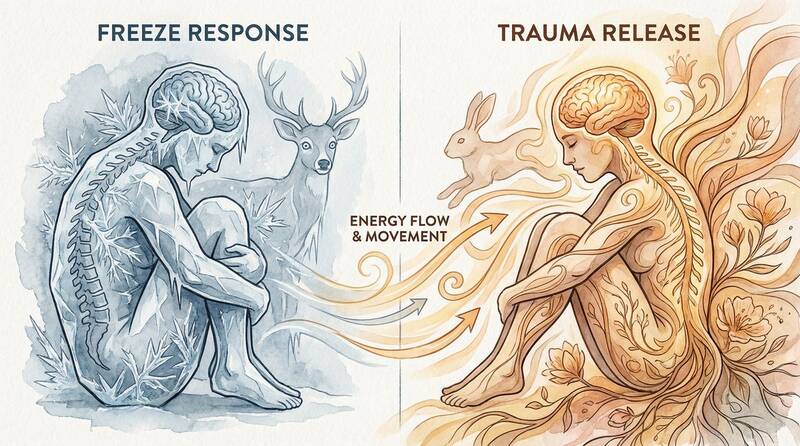
The journey from freeze response to trauma release through SE
How SE Works
The Somatic Experiencing approach facilitates the completion of self-protective motor responses and the release of thwarted survival energy bound in the body, thus addressing the root cause of trauma symptoms.
This is approached by gently guiding clients to develop increasing tolerance for difficult bodily sensations and suppressed emotions, and working to complete defensive responses previously thwarted from bringing resolution to the nervous system.
The SIBAM Model
Levine's SIBAM model maps the five channels through which experience organizes itself. In healthy functioning, all five channels are coupled ~ flowing together as an integrated whole. Trauma decouples them: a client may have vivid images but no sensation, or overwhelming affect with no meaning-making.
The SE practitioner tracks all five channels simultaneously, noticing which are over-coupled (fused together) and which are under-coupled (dissociated). The therapeutic work is to gently restore coupling ~ not by forcing integration, but by titrating awareness across channels until the nervous system can hold them together again.
Internal body feelings: temperature, pressure, tingling, hollowness, tightness
Visual, auditory, olfactory ~ any sensory representation including flashbacks and body images
Voluntary and involuntary movement: gestures, posture, facial expression, trembling
Emotions and feelings: fear, anger, sadness, joy, shame, disgust
Cognitive interpretations, beliefs, narratives, and the stories we tell about experience
"When all five SIBAM elements are bound together in a unified whole, the experience is complete and can be assimilated. When they are fragmented ~ as in trauma ~ the person is left with disconnected pieces that intrude as symptoms."
~ Peter A. Levine, In an Unspoken Voice (2010)
Over-Coupling (Fusion)
Two or more channels locked together so tightly that activating one automatically triggers the other.
- Image + Affect: seeing a face triggers instant rage
- Sensation + Meaning: stomach tightness = "I'm going to die"
- Behavior + Affect: any anger triggers freezing
Under-Coupling (Dissociation)
Channels disconnected from each other ~ the person can access one but not the others.
- Narrative without affect: tells the story with no emotion
- Sensation without meaning: body pain with no context
- Affect without behavior: feels terror but body is frozen
Trauma Vortex & Healing Vortex
Levine describes two opposing forces in the nervous system. The trauma vortex pulls the client into the chaos of unresolved activation ~ flashbacks, overwhelm, constriction. The healing vortex draws toward equilibrium, expansion, and integration. SE works by strengthening the healing vortex until it can contain and transform the trauma vortex.
Trauma Vortex
Pulls toward chaos and overwhelm
- Constriction, bracing, collapse
- Flashbacks, intrusive images
- Helplessness, terror, rage
- Dissociation, numbing, shutdown
- Time distortion (past feels present)
Healing Vortex
Draws toward integration and equilibrium
- Expansion, openness, flow
- Present-moment awareness
- Curiosity, aliveness, vitality
- Connection, grounding, safety
- Discharge, trembling, completion
Pendulation: The Bridge Between Vortexes
Pendulation is the SE practitioner's primary tool. It involves gently guiding the client's attention back and forth between the trauma vortex (activation, distress) and the healing vortex (resource, calm). This oscillation teaches the nervous system that it can touch activation without being consumed by it.
Each cycle of pendulation builds capacity. The nervous system learns: "I can be activated and come back." Over time, the healing vortex grows stronger and the trauma vortex loses its gravitational pull.
"Traumatized people are often afraid of their bodily sensations. The experience of fear itself can become the enemy. SE helps people befriend their sensations and learn that they can move through activation to a place of resolution."
~ Peter A. Levine, Waking the Tiger (1997)
Neuroscience
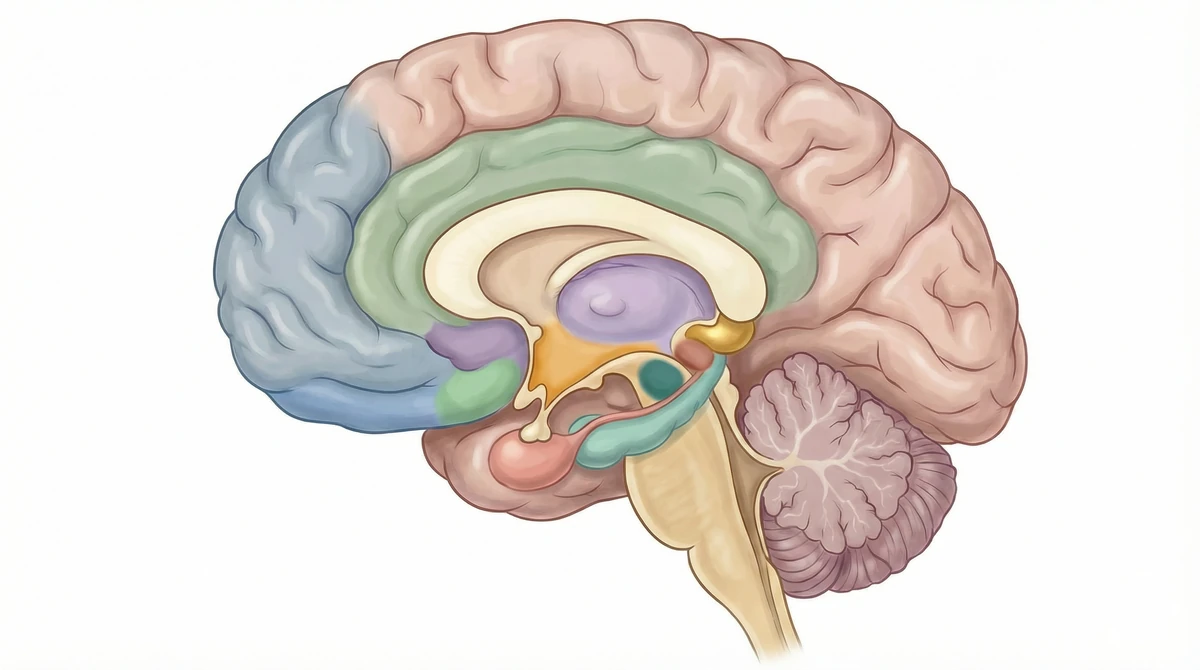
Understanding the brain regions targeted by Somatic Experiencing helps clinicians appreciate how SE works bottom-up through the nervous system to resolve trauma.
Brain Regions Targeted by Somatic Experiencing
Click on any brain region to explore how SE works bottom-up through the nervous system.
Keep this guide free.
Five foundational practices for working with the body's innate healing capacity· Click any technique for clinical details
Resourcing
Connecting to inner safety and grounding
The practice of inviting the mind and body to attune to sensations of safety or goodness. Builds capacity before approaching difficult material ~ can be internal (memories, images) or external (objects, places).
Tracking
Following bodily sensations moment to moment
Moment-to-moment awareness of body sensations ~ temperature, pressure, movement, stillness. The therapist tracks the client's nonverbal cues while supporting completion of incomplete responses.
Titration
Less is more, slower is better
Working with small, manageable doses of traumatic material to prevent overwhelm. Counters trauma being 'too much, too fast, too soon' ~ borrowed from chemistry, adding small amounts gradually.
Pendulation
Natural rhythm between expansion and contraction
The natural pulsation between states of expansion and contraction in the nervous system ~ like the ebb and flow of ocean tides. Introduces resourced states into awareness and allows polarities to gradually integrate.
Discharge
Release of trapped survival energy
The natural release of energy that was bound during the traumatic event. May manifest as trembling, shaking, heat, or sweating ~ the natural completion of the fight/flight response that should be allowed to complete.
"Trauma is not what happens to us, but what we hold inside in the absence of an empathetic witness" ~ Peter Levine
Detailed descriptions, clinical notes, and quotes for each technique
Less is more, slower is better
Natural rhythm between expansion and contraction
Connecting to inner safety and grounding
Following bodily sensations moment to moment
Release of trapped survival energy
Working with Complex Trauma
Somatic Experiencing was developed with trauma in mind, but complex developmental trauma requires additional considerations. The nervous system patterns are more deeply ingrained and intertwined with identity.
Complex trauma clients often have limited internal resources. Spend significant time building capacity before touching trauma.
- Build multiple somatic resources first
- Establish reliable grounding anchors
- Practice pendulation with non-trauma material
Standard titration may still be too much. With complex trauma, work with the smallest possible "drops" of activation.
- Touch activation for seconds, not minutes
- Return to resource immediately
- Build tolerance incrementally over sessions
Working with Chronic Freeze
Complex trauma often results in chronic freeze states ~ the nervous system stuck in immobility. This requires patient, gradual thawing rather than direct trauma processing.
Signs of Chronic Freeze
- • Persistent numbness or disconnection
- • Difficulty feeling body sensations
- • Collapsed posture, low energy
- • Dissociation as default state
Thawing Approach
- • Start with orienting to present environment
- • Invite tiny movements ~ micro-movements
- • Track even subtle sensations with curiosity
- • Allow trembling and discharge when it arises
Developmental Trauma Considerations
When trauma occurred during development, the nervous system never learned healthy regulation. The work is not just releasing trauma but building capacities that never developed.
Building Missing Capacities
- Co-regulation: Use therapeutic presence to model regulation
- Rhythm: Establish healthy activation/settling cycles
- Boundaries: Develop felt sense of healthy boundaries
- Agency: Support experiences of effective action
Key Clinical Insight
With complex trauma, the goal shifts from "processing trauma" to "building a regulated nervous system." The trauma will process naturally as the system develops capacity. Trust the body's wisdom ~ it will only release what it can integrate.
Complementary Approaches
Somatic Experiencing integrates well with other trauma modalities. Each approach offers unique contributions to complex trauma work:
Deep Brain Reorienting
Brainstem-level processing and orienting tension
EMDR
Bilateral processing for memory reconsolidation
Sensorimotor
Body-based processing and movement
Gestalt
Relational presence and dialogue
Internal Family Systems
Parts work and Self-leadership
Neurofeedback
Brain wave training for regulation
Complex Trauma Comparison Chart
A comprehensive guide comparing when to use each modality's specific complex trauma modifications. Includes clinical decision trees, sequencing considerations, and at-a-glance comparison tables.
Session Language
Clinical prompts and phrases organized by technique for use in SE sessions
Glossary
Key terms and concepts in Somatic Experiencing.
Somatic Experiencing Quick Reference Card
Comprehensive printable PDF for clinical use
Showing 18 of 18 terms
Further Reading
Foundational Texts
Research
Somatic experiencing - effectiveness and key factors of a body-oriented trauma therapy: a scoping literature review
Kuhfuß et al. (2021)
Systematic review examining SE effectiveness and identifying key therapeutic factors.
Full Text PDFSomatic Experiencing for Posttraumatic Stress Disorder: A Randomized Controlled Outcome Study
Brom et al. (2017)
RCT demonstrating SE effectiveness for PTSD symptoms.
Full Text PDFSomatic experiencing: using interoception and proprioception as core elements of trauma therapy
Payne, Levine & Crane-Godreau (2015)
Theoretical paper on the role of body awareness in SE.
Full Text PDFVeterans' experiences of Somatic Experiencing and Prolonged Exposure therapies for post-traumatic stress disorder: A qualitative analysis
Briggs et al. (2020)
Qualitative study comparing veterans' experiences of SE and PE for PTSD treatment.
Full Text PDF