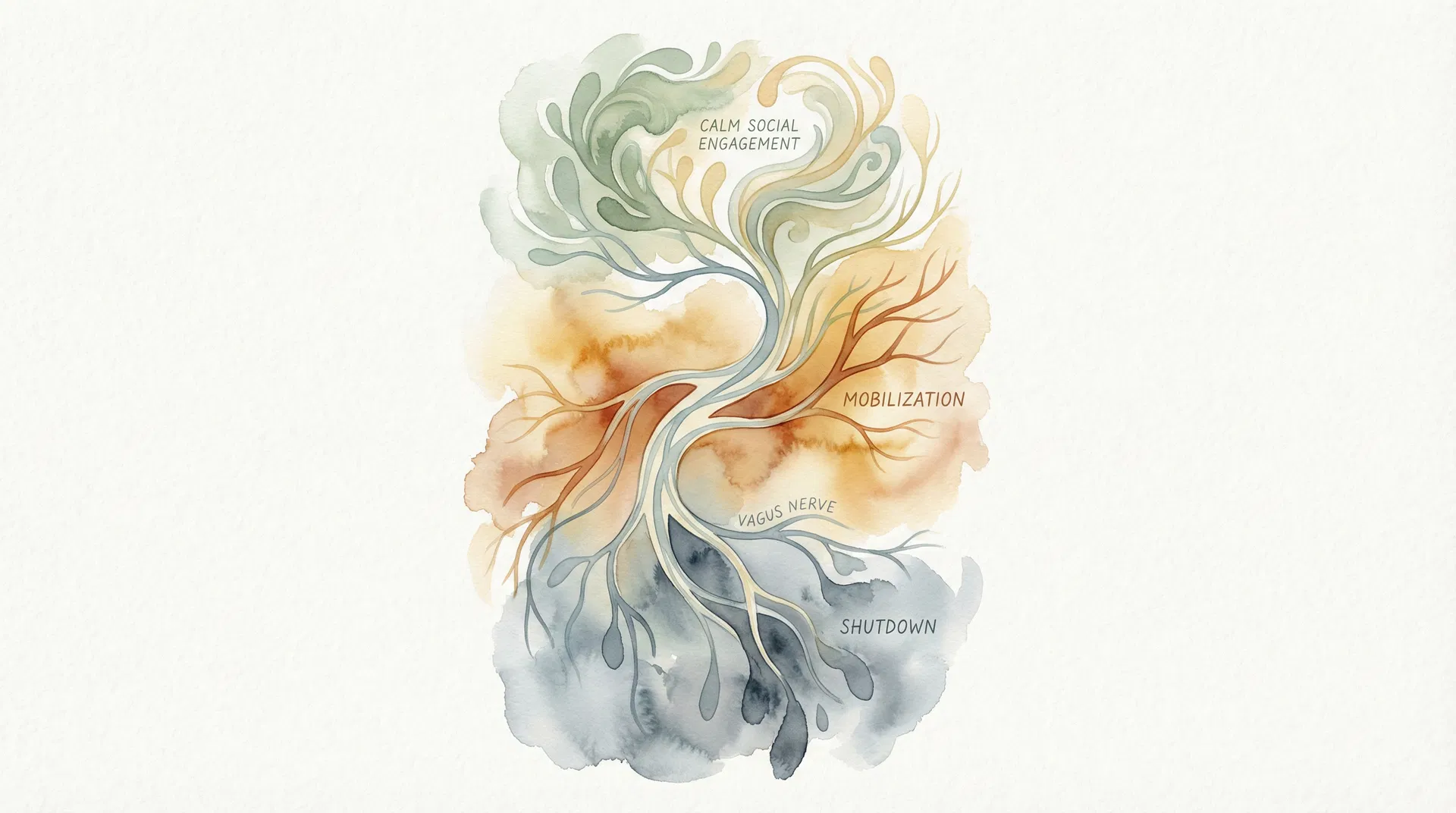
Polyvagal Theory
How the autonomic nervous system's three-part hierarchy shapes our capacity for safety, connection, and healing ~ and why trauma is a disorder of neuroception, not cognition.
Developed by Stephen W. Porges, PhD (1994)
CEUs are being negotiated. Post-tests, certificates, and CE credit are not currently available.
Polyvagal Theory in Clinical Practice: The Autonomic Nervous System and Trauma Treatment
Target Audience: Licensed mental health professionals (psychologists, clinical social workers, licensed professional counselors, marriage and family therapists)
This module provides a comprehensive overview of Stephen W. Porges' Polyvagal Theory (PVT), a neurophysiological framework that has fundamentally reshaped how clinicians understand the autonomic nervous system's role in trauma, attachment, and social behavior. We will examine the theory's core proposition: that the mammalian autonomic nervous system comprises three hierarchically organized subsystems ~ the ventral vagal complex (social engagement), the sympathetic nervous system (mobilization), and the dorsal vagal complex (immobilization) ~ and that these subsystems are recruited in a phylogenetically determined sequence in response to perceived threat. The concept of neuroception, the unconscious detection of safety and danger, will be explored as a central mechanism driving autonomic state shifts.
The clinical application of Polyvagal Theory is particularly salient for trauma therapists. This module will illuminate how chronic trauma dysregulates the autonomic hierarchy, leaving clients stuck in sympathetic hyperarousal or dorsal vagal shutdown. We will explore the concept of co-regulation ~ the mutual regulation of physiological states between individuals ~ and its implications for the therapeutic relationship. The social engagement system, which Porges describes as the 'face-heart connection,' will be examined as both a clinical assessment tool and a therapeutic target. Clinicians will learn to read autonomic state through observable markers including facial expression, vocal prosody, eye contact, and postural tone.
The integration of Polyvagal Theory across trauma treatment modalities will be a key focus. We will examine how PVT informs the clinical application of Deep Brain Reorienting, Somatic Experiencing, EMDR, Internal Family Systems, Sensorimotor Psychotherapy, and other body-based approaches. The module will also address the scientific debate surrounding PVT, distinguishing between the theory's well-supported clinical heuristic value and the ongoing neuroanatomical discussions in the research literature. By completing this module, clinicians will be able to apply a polyvagal lens to case conceptualization, recognize autonomic state shifts in session, and use co-regulation as a deliberate clinical intervention.
Upon completion of this module, the learner will be able to:
- 1Describe the three autonomic subsystems identified in Polyvagal Theory (ventral vagal, sympathetic, dorsal vagal) and their associated physiological and behavioral characteristics.
- 2Define neuroception and explain its role in driving autonomic state shifts below the level of conscious awareness.
- 3Apply the concept of co-regulation to the therapeutic relationship, identifying specific clinician behaviors that promote ventral vagal engagement in clients.
- 4Differentiate between adaptive and maladaptive autonomic responses in the context of trauma, recognizing how faulty neuroception maintains trauma-related symptoms.
- 5Integrate polyvagal-informed assessment into clinical practice by identifying observable markers of autonomic state including facial expression, vocal prosody, and postural tone.
CEUs are being negotiated. Post-tests, certificates, and CE credit are not currently available. The course overview and learning objectives are available now for educational use. Planned contact hours for this module: 1.5.
Understanding Polyvagal Theory
Polyvagal Theory (PVT), introduced by Stephen W. Porges in 1994, provides a neurophysiological framework for understanding how the autonomic nervous system mediates our capacity for safety, social engagement, and defense. The theory's name comes from the poly (many) branches of the vagus nerve ~ the longest cranial nerve in the body, running from the brainstem to the viscera ~ and its central insight is that this nerve has two functionally distinct branches with very different roles.
Before Polyvagal Theory, the autonomic nervous system was understood as a two-part system: sympathetic (accelerator) and parasympathetic (brake). Porges demonstrated that this model was incomplete. The parasympathetic system actually contains two vagal circuits with opposing functions ~ one that supports social engagement and one that produces shutdown. This distinction has profound implications for understanding trauma, dissociation, and the therapeutic relationship.
For clinicians, PVT offers something that purely cognitive models cannot: an explanation for why trauma survivors behave in ways that seem irrational. A client who freezes during a therapy session is not being resistant ~ their dorsal vagal system has taken over. A client who cannot make eye contact is not being avoidant ~ their social engagement system is offline. Understanding this changes everything about how we approach treatment.
In Curran's interview, Dr. Stephen Porges ~ the developer of Polyvagal Theory ~ discusses the three autonomic states, neuroception, and how the theory applies to trauma regulation and clinical practice.
Three Autonomic States
Polyvagal Theory identifies three distinct autonomic states, organized in a phylogenetic hierarchy. Under threat, the nervous system moves down the hierarchy ~ from social engagement to mobilization to immobilization. Healing moves up ~ from shutdown through mobilization back to social engagement.
Social Engagement System
The ventral vagal complex is the newest branch of the autonomic nervous system, unique to mammals. When this system is dominant, we feel safe, connected, and capable of social engagement. The myelinated ventral vagus acts as a 'vagal brake' ~ it can rapidly modulate heart rate without activating the sympathetic system, allowing for the subtle physiological shifts that support face-to-face communication, prosody, and attunement.
Physiology
- Myelinated vagus nerve (cranial nerve X) ~ the 'smart vagus'
- Innervates muscles of the face, middle ear, larynx, pharynx
- Regulates heart rate via the vagal brake mechanism
- Supports prosody (vocal intonation), facial expression, and listening
Lived Experience
- Feeling safe, calm, and present
- Capacity for curiosity, play, and intimacy
- Able to think clearly and make decisions
- Connected to self and others
- Flexible and adaptive responses
Clinical Note: This is the state we are trying to help clients access and sustain. It is not about being calm all the time ~ it is about having the flexibility to move through states and return to ventral vagal regulation. Porges calls this the 'neural platform' for social engagement.
Mobilization / Fight-Flight
When neuroception detects danger, the sympathetic nervous system mobilizes the body for action. Heart rate increases, blood flows to large muscles, digestion shuts down, and the body prepares to fight or flee. This is not a conscious decision ~ it is an automatic, subcortical response. In trauma, the sympathetic system can become chronically activated, leaving clients in a persistent state of hyperarousal.
Physiology
- Spinal sympathetic chain ~ thoracolumbar outflow
- Releases adrenaline and noradrenaline
- Increases heart rate, blood pressure, respiration
- Diverts blood from viscera to skeletal muscles
Lived Experience
- Anxiety, panic, hypervigilance
- Racing heart, shallow breathing, muscle tension
- Irritability, anger, rage
- Restlessness, inability to sit still
- Difficulty concentrating, racing thoughts
Clinical Note: Clients stuck in sympathetic activation often present with anxiety disorders, panic, anger management issues, or ADHD-like symptoms. The key clinical question is whether the mobilization is adaptive (responding to real danger) or maladaptive (neuroception of danger in a safe environment).
Immobilization / Shutdown
The dorsal vagal complex is the most ancient branch of the autonomic nervous system, shared with reptiles. When neuroception detects life threat ~ and fight or flight has failed or is impossible ~ the dorsal vagus activates immobilization. Heart rate drops, blood pressure falls, and the organism enters a state of conservation and withdrawal. In humans, this manifests as dissociation, numbness, collapse, and the 'freeze' response.
Physiology
- Unmyelinated vagus nerve ~ the 'vegetative vagus'
- Slows heart rate below resting baseline (bradycardia)
- Reduces metabolic output and oxygen consumption
- Can produce syncope (fainting) in extreme activation
Lived Experience
- Numbness, disconnection, 'not here'
- Feeling frozen, unable to move or speak
- Fatigue, lethargy, hopelessness
- Dissociation, depersonalization
- Shame, worthlessness, collapse
Clinical Note: Dorsal vagal shutdown is the body's last-resort defense. It is not laziness, resistance, or lack of motivation ~ it is a neurobiological survival strategy. Clients in dorsal vagal states need co-regulation and gentle activation, not confrontation or pressure. Release breathing (long slow out-breaths) should NOT be used here ~ it will deepen the shutdown.
Free education for trauma clinicians. Funded by clinicians.
Core Principles of Polyvagal Theory
Polyvagal Theory & the Window of Tolerance
Dan Siegel's Window of Tolerance maps directly onto the polyvagal hierarchy. The window is the range of ventral vagal regulation ~ where a person can process emotions, think clearly, and engage socially. Hyperarousal (above the window) corresponds to sympathetic activation ~ fight, flight, panic. Hypoarousal (below the window) corresponds to dorsal vagal shutdown ~ collapse, numbness, dissociation.
Above the Window
Sympathetic activation
Hyperarousal, anxiety, panic, rage
Within the Window
Ventral vagal regulation
Present, connected, flexible
Below the Window
Dorsal vagal shutdown
Numb, collapsed, dissociated
Polyvagal-Informed Session Language
Language that reflects polyvagal understanding helps clients make sense of their experience without pathologizing it. The goal is to name what the nervous system is doing ~ and to normalize it as adaptive.
From the Literature
"The autonomic nervous system is not merely a physiological system ~ it is the neural platform upon which social behavior and psychological experience are built."
~ Stephen W. Porges, The Polyvagal Theory, Norton, 2011
"Safety is not the removal of threat. Safety is a neuroception ~ an unconscious detection of features in the environment that signal the absence of danger and the presence of connection."
~ Stephen W. Porges, Polyvagal Theory: A Science of Safety, Frontiers in Integrative Neuroscience, 2022
"Our nervous system is always asking one question: Am I safe? And it answers that question not with thoughts, but with the body."
~ Deb Dana, The Polyvagal Theory in Therapy, Norton, 2018
"Co-regulation is not a luxury. It is a biological imperative. Mammals cannot regulate alone ~ we are wired to regulate together."
~ Stephen W. Porges, Clinical Applications of the Polyvagal Theory, Norton, 2018
Polyvagal Theory Across Modalities
Polyvagal Theory is not a standalone treatment ~ it is a framework that informs every body-based and relational modality on this site. Here is how each modality integrates polyvagal principles.
A Note on the Scientific Debate
Polyvagal Theory has been enormously influential in clinical practice, and its core metaphors ~ the autonomic hierarchy, neuroception, co-regulation ~ have given clinicians and clients a shared language for understanding trauma responses. At the same time, some of PVT's specific neuroanatomical claims have been challenged by comparative physiologists and neuroscientists.
A 2023 paper by Grossman and colleagues questioned whether the phylogenetic hierarchy is supported by comparative anatomy, and whether the myelinated/unmyelinated vagal distinction maps as cleanly onto mammalian evolution as originally proposed. Porges has responded to these critiques in subsequent publications (2025), arguing that the theory has been mischaracterized and that its core predictions remain supported.
This is how science works. The clinical utility of PVT's framework ~ helping clients understand their nervous system responses as adaptive rather than pathological ~ is not diminished by ongoing refinement of its neuroanatomical claims. What matters for the clinician is whether the framework helps you help your clients. For most trauma therapists, the answer remains yes.
Resources & References
Polyvagal Theory Quick Reference Card
1-page PDF ~ Three states, core concepts, session language, modality connections
Peer-Reviewed Articles
Polyvagal Theory: A Science of Safety
Porges, S.W. (2022). Frontiers in Integrative Neuroscience.
Porges reframes Polyvagal Theory through the lens of safety as a biological imperative, showing how neuroception of safety enables social engagement and health.
Polyvagal Theory: Current Status, Clinical Applications, and Future Directions
Porges, S.W. (2025). Clinical Neuropsychiatry.
Comprehensive update on PVT covering its current scientific status, clinical applications across therapeutic modalities, and directions for future research.
The polyvagal theory: New insights into adaptive reactions of the autonomic nervous system
Porges, S.W. (2009). Cleveland Clinic Journal of Medicine.
Accessible overview of PVT's core principles, including the autonomic hierarchy and the role of the vagus nerve in adaptive stress responses.
Polyvagal theory: A journey from physiological observation to neural innervation and clinical insight
Porges, S.W. (2025). Frontiers in Behavioral Neuroscience.
Porges traces the development of PVT from his early heart rate variability research through its evolution into a clinical framework for understanding trauma and social behavior.
Essential Books
The Polyvagal Theory: Neurophysiological Foundations of Emotions, Attachment, Communication, and Self-Regulation
Stephen W. Porges
Norton, 2011
Clinical Applications of the Polyvagal Theory: The Emergence of Polyvagal-Informed Therapies
Stephen W. Porges & Deb Dana (Eds.)
Norton, 2018