
Neurofeedback
A non-invasive technique using brain/computer interface technology to help individuals learn to change their brain wave patterns, restoring regulatory capacity and reducing symptoms related to trauma, anxiety, and dysregulation.
Key Contributors: Sebern Fisher, Ed Hamlin, Bessel van der Kolk

CEUs are being negotiated. Post-tests, certificates, and CE credit are not currently available.
Neurofeedback for Trauma Treatment
Target Audience: Licensed mental health professionals (psychologists, clinical social workers, licensed professional counselors, marriage and family therapists)
Neurofeedback, a specialized form of biofeedback, is a therapeutic intervention that provides real-time feedback on brainwave activity to facilitate self-regulation. Its origins are rooted in the principles of operant conditioning, where the brain is rewarded for producing more regulated patterns, and neuroplasticity, the brain's innate capacity to reorganize itself by forming new neural connections. The process involves placing electrodes on the scalp according to the internationally recognized 10-20 system to measure electroencephalographic (EEG) data. This information is then presented to the individual through visual or auditory feedback, allowing them to learn how to modulate their own brainwave frequencies, such as delta, theta, alpha, SMR, beta, and gamma, to achieve a more balanced and functional state.
The primary clinical application of neurofeedback in trauma treatment is its ability to directly address the neurophysiological dysregulation that results from adverse experiences. Unlike traditional talk therapies, neurofeedback targets the underlying brainwave patterns associated with trauma, such as elevated high-beta activity (hypervigilance), excess theta (dissociation), and alpha asymmetry (depression/withdrawal). By training the brain to de-emphasize these maladaptive patterns and promote more regulated ones, clients can experience a reduction in symptoms like anxiety, intrusive thoughts, and emotional reactivity. This approach is unique in that it empowers the client to develop greater self-regulation skills from the "bottom-up," creating a foundation of physiological stability that can enhance the efficacy of other therapeutic modalities.
The evidence base for neurofeedback in trauma treatment has been growing, with significant contributions from researchers like Bessel van der Kolk, who has highlighted its effectiveness in his work, and Sebern Fisher, who has extensively written about its application for developmental and complex trauma. This module will provide clinicians with a comprehensive understanding of the neurophysiological underpinnings of trauma and how neurofeedback can be used as a powerful tool to address them. Participants will learn to identify common trauma-related brainwave patterns through Quantitative EEG (QEEG) brain mapping and explore various neurofeedback protocols, such as alpha-theta and SMR training, to help clients achieve lasting symptom reduction and improved overall functioning.
Upon completion of this module, the learner will be able to:
- 1Describe the theoretical foundations of neurofeedback, including operant conditioning and neuroplasticity.
- 2Identify the five primary brain wave frequencies (Delta, Theta, Alpha, Beta, Gamma) and their relevance to clinical presentations.
- 3Differentiate between common QEEG brain mapping patterns observed in clients with trauma histories.
- 4Explain the application of at least two common neurofeedback protocols (e.g., Alpha-Theta, SMR) for trauma resolution.
- 5Analyze the role of neurofeedback in promoting self-regulation and its application in complex trauma cases, citing the work of key researchers.
CEUs are being negotiated. Post-tests, certificates, and CE credit are not currently available. The course overview and learning objectives are available now for educational use. Planned contact hours for this module: 2.
Featured Video
Dr. Bessel van der Kolk and Sebern Fisher discuss the role of Neurofeedback in trauma treatment.
What is Neurofeedback?
See also: Window of Tolerance - a foundational concept across all trauma modalities.
Neurofeedback (NFB), also known as EEG biofeedback, is a non-invasive technique for modeling human brain function. Using brain/computer interface technology, it permits individuals to learn to change the pattern of their electroencephalogram (EEG) through operant conditioning ~ the brain learns to produce desired frequencies when rewarded with visual and auditory feedback.
"Neurofeedback offers restoration of regulatory capacity ~ necessary not only for tolerating the traumatic past but for transforming it."
~ Sebern Fisher
Core Principles
Neuroplasticity
The brain can reorganize itself by forming new neural connections ~ NFB leverages this to literally rewire the brain
Operant Conditioning
The brain learns to produce desired frequencies when rewarded with feedback signals
Self-Regulation
Goal is reestablishing the brain's regulatory capacity, reducing hyper- or hypoarousal symptoms
Non-Invasive
Sensors only read electrical signals ~ nothing is put into the brain
Understanding Brain Wave Frequencies
Click each frequency band to reveal detailed characteristics and clinical notes
The brain organizes itself in the rhythmic domain of frequencies. Different frequencies are associated with different mental states, and trauma can disrupt these patterns. Understanding brain waves is essential for effective neurofeedback treatment.
Key Clinical Insight
Trauma survivors often show characteristic patterns: elevated high beta (hyperarousal/anxiety), excess theta (dissociation/cognitive fog), and alpha asymmetry (depression/emotional dysregulation). QEEG assessment helps identify which patterns are present to guide protocol selection.
How Neurofeedback Works
- 1Sensors placed on scalp measure EEG activity
- 2Computer processes brain wave data in real-time
- 3Visual/auditory feedback provided when target frequencies occur
- 4Brain learns to produce desired patterns through reinforcement
- 5With practice, changes become more stable and lasting
Based on the Yerkes-Dodson Law, neurofeedback helps regulate arousal levels:
Overarousal
Elevated fast beta, low alpha → anxiety, agitation, hypervigilance, muscle tension
Optimal Arousal
Balanced frequencies → calm alertness, flexible response, good regulation
Underarousal
Excess alpha/theta → depression, attention problems, low motivation, dissociation
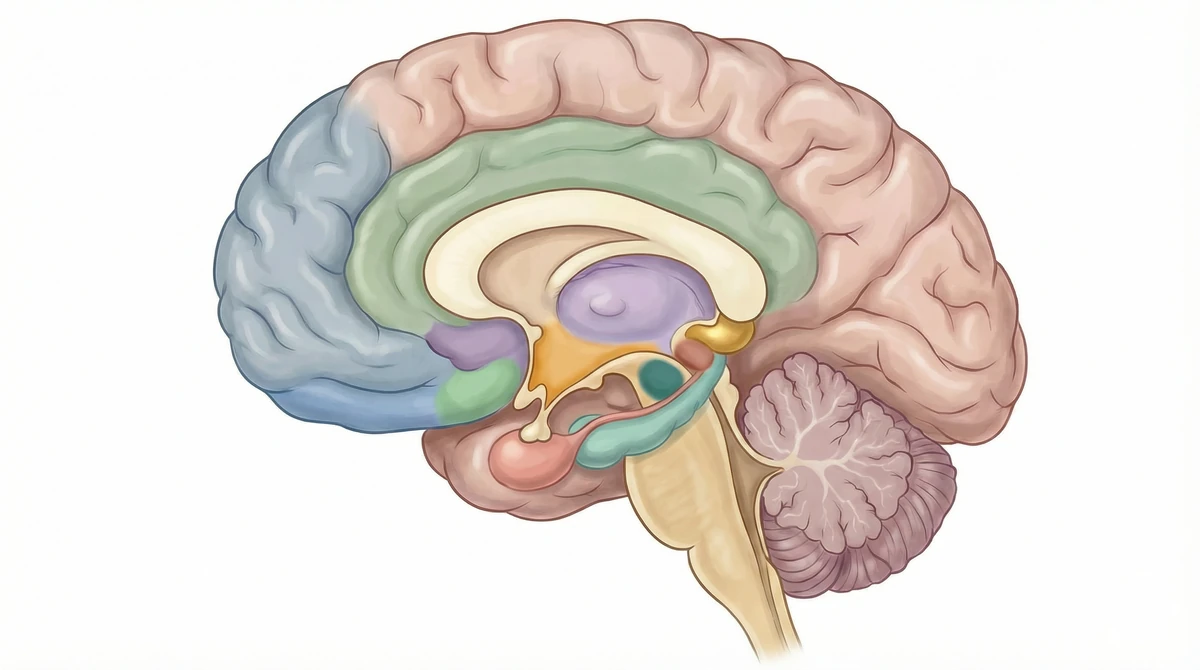
Brain Regions Trained by Neurofeedback
Understanding the brain regions trained by neurofeedback helps clinicians appreciate how EEG-based protocols target specific neural networks.
Brain Regions Trained by Neurofeedback
Click on any brain region to explore how neurofeedback protocols target it.
Keep this guide free.
Why Neurofeedback for Trauma?
"The verbal narrative of a traumatic event is rarely sufficient to resolve complex traumatization. We need methods that lead to more stable windows of tolerance."
~ Anna Gerge, European Journal of Trauma & Dissociation
Brain Changes in Trauma
Trauma clients suffer significant deficits in specific brain regions. Structural and functional anomalies occur in the frontal cortex, prefrontal cortex, cingulate gyrus, temporal lobes, and medial and limbic structures. These affect working memory, information processing, abstract thinking, planning, and executive functions.
Amygdala Overactivity
Increased amygdala activity in PTSD leads to hypervigilance and increased avoidance
Reduced Connectivity
Traumatized individuals show reduced connectivity between brain areas
Dysregulated Arousal
Prolonged intense fear affects brain function, narrowing the window of tolerance
Implicit Dysregulation
NFT aims at implicit (preverbal) regulation where other methods may fail
- Improves connections between brain areas, notably temporal cortical regions, hippocampus, and amygdala
- Strengthening alpha wave activity in right frontal region leads to symptom reduction
- Helps nervous system get quietened down ~ almost 100% of the time with developmental trauma
- Builds capacity for processing trauma without being overwhelmed
- Can help traumatized children and adults normalize brainwaves
- After treatment: clients can deal with emotions, be attentive, focused on learning, meeting goals
QEEG Assessment
What is QEEG?
Quantitative Electroencephalogram (QEEG) is a valid and reliable assessment tool using 19+ electrodes to objectively evaluate a client's brainwave function. Data is compared to normative databases to identify deviations.
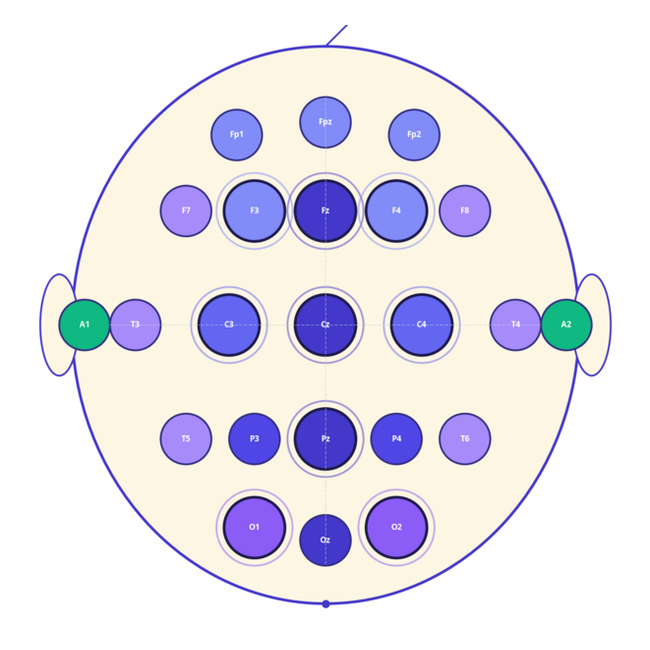
10-20 System
International standard for electrode placement with 19 standardized locations on the scalp. Sites are individually selected based on the therapist's assessment.
Assessment Procedure
- 160-75 minute session
- 2Snug cap with electrodes placed on scalp
- 3Eyes closed condition recorded
- 4Eyes open condition recorded
- 5Task conditions may be included
- 6Data compared to normative database
10-20 Electrode Placement System
Understanding electrode placement is essential for interpreting QEEG findings and planning neurofeedback protocols. The international 10-20 system provides standardized positions for consistent assessment and training.
Standard 10-20 System
Complete electrode positions with anatomical references
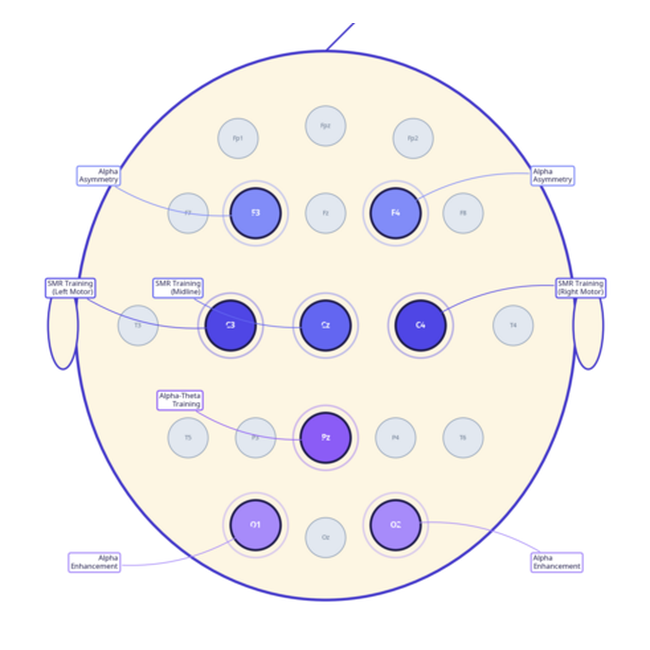
Common Training Sites
Key electrode positions for neurofeedback protocols
Position Naming Convention
- F = Frontal, C = Central, P = Parietal
- T = Temporal, O = Occipital
- Odd numbers = Left hemisphere
- Even numbers = Right hemisphere
- z = Midline (zero)
Clinical Note
Site selection depends on QEEG findings and clinical presentation. C3/C4 (sensorimotor) are common starting points for arousal regulation, while Pz is often used for alpha-theta training in trauma work.
QEEG Brain Maps in Trauma
Quantitative EEG (QEEG) brain mapping compares an individual's brain wave patterns to normative databases, revealing dysregulation patterns common in trauma. These maps guide treatment protocol selection and track progress.
Click each pattern to reveal the brain map, clinical presentation, and training targets
Clinical Note: QEEG Interpretation
QEEG brain maps are screening tools, not diagnostic instruments. Patterns shown here are common but not universal in trauma populations. Individual assessment is essential, as many trauma survivors show mixed patterns or different presentations. Always correlate QEEG findings with clinical history, symptoms, and presentation. Training protocols should be individualized based on comprehensive assessment.
Common Neurofeedback Protocols
Click each protocol to reveal sites, indications, and mechanisms
Before & After: QEEG Treatment Progress
These examples show typical QEEG changes observed after neurofeedback treatment for trauma. The "Change" map highlights areas of improvement (blue = normalized activity).
Click each treatment outcome to see before/after brain maps and clinical results
Important Clinical Note
These are representative examples based on typical treatment outcomes. Individual results vary based on trauma history, treatment duration, protocol selection, and concurrent therapies. QEEG changes typically emerge after 20-40 sessions, with clinical symptom improvement often preceding measurable brain changes.
Session Language Examples
Modifications for Complex Trauma
"It is not the overwhelming event but the ongoing dysregulation that is the problem. Prolonged intense fear affects brain function ~ the amygdala overreacts, the hippocampus shrinks."
~ Anna Gerge
Extended Stabilization Phase
Begin with SMR training at C4 to calm the nervous system before any deeper work. May require 20-40 sessions of stabilization alone.
Rationale: Developmental trauma requires extensive nervous system calming before the brain can learn new patterns.
Slower Pace of Training
Use shorter training segments (2-3 minutes) with breaks. Monitor for signs of overwhelm or dissociation.
Rationale: Traumatized brains can become easily overwhelmed. Titration prevents flooding.
Careful Protocol Selection
Avoid alpha-theta training until significant stabilization is achieved. Start with SMR and low beta protocols.
Rationale: Deep state protocols can trigger traumatic material before the client has resources to manage it.
Integration with Psychotherapy
Combine neurofeedback with trauma-informed psychotherapy. NFB builds capacity; therapy processes content.
Rationale: Neurofeedback alone doesn't process trauma - it creates the neurological foundation for processing.
Attention to Dissociation
Monitor for elevated 3-6 Hz theta, which indicates dissociative states. Adjust protocols to reduce dissociation.
Rationale: Dissociation is common in complex trauma and can interfere with learning.
Building Window of Tolerance
Focus on expanding the client's window of tolerance through gradual arousal regulation training.
Rationale: The primary goal is helping the client tolerate more activation without becoming dysregulated.
Contraindications & Considerations
Key Terms
Research, Training & Resources
van der Kolk et al. (2016)
Randomized controlled trial showing significant PTSD symptom reduction with neurofeedback
Gapen et al. (2016)
Chronic complex PTSD patients (therapy-resistant, 10+ years prior therapy) showed good results on all PTSD symptoms using only two stabilizing NFT positions
Kleutsch et al. (2014)
Increased activity in default mode network (DMN), increased calmness ~ improvement seen after just one session
Teicher, Samson, Anderson, & Ohashi (2016)
Comprehensive review of neurobiological effects of chronic traumatic exposure
Click each item to reveal detailed information and contact details
Sebern Fisher, author of Neurofeedback in the Treatment of Developmental Trauma: Calming the Fear-Driven Brain, recommends the following training pathways for clinicians interested in incorporating neurofeedback into their practice.
Neurofeedback Quick Reference Card
A comprehensive PDF with brain wave frequencies, training protocols, complex trauma modifications, session language examples, and key resources.
Academic Resources
Foundational/Seminal Studies
Randomized Controlled Trials
A randomized, controlled trial of alpha-rhythm EEG neurofeedback in PTSD
Full TextNicholson, A.A., Ros, T., Densmore, M., et al. • (2020)
Double-blind, sham-controlled RCT; 61.1% of experimental group no longer met PTSD criteria vs. 33.3% sham; fMRI evidence of restored DMN and salience network connectivity
The impact of neurofeedback training on children with developmental trauma: A randomized controlled study
Abstract OnlyRogel, A., Loomis, A.M., Hamlin, E., Hodgdon, H., Spinazzola, J., & van der Kolk, B. • (2020)
First RCT with children ages 6-13; 24 sessions significantly decreased PTSD symptoms, internalizing/externalizing behaviors, improved executive functioning
Systematic Reviews & Meta-Analyses
Neurofeedback for PTSD: Systematic review and meta-analysis of clinical and neurophysiological outcomes
Full TextAskovic, M., Watters, A.J., Coello, M., et al. • (2023)
Meta-analysis of 10 clinical trials; SMD of -1.76 (large effect); 79.3% remission rate in NFB groups vs. 24.4% controls; only 5% dropout rate