
Structural Dissociation
Understanding how the personality fragments in response to overwhelming experience ~ the foundation for trauma-informed treatment across all modalities.
Key Contributors: Onno van der Hart, Ellert Nijenhuis, Kathy Steele

CEUs are being negotiated. Post-tests, certificates, and CE credit are not currently available.
Understanding and Working with Structural Dissociation of the Personality
Target Audience: Licensed mental health professionals (psychologists, clinical social workers, licensed professional counselors, marriage and family therapists)
The Theory of Structural Dissociation of the Personality, developed by Onno van der Hart, Ellert Nijenhuis, and Kathy Steele, provides a comprehensive framework for understanding the complex post-traumatic conditions that arise from chronic childhood trauma. This model posits that the personality of a traumatized individual divides into distinct parts, primarily categorized as the Apparently Normal Part (ANP) and the Emotional Part (EP). The ANP manages daily life functions, often presenting as the host personality, while EPs hold the traumatic memories, sensorimotor experiences, and defense responses. This division is not a sign of multiple personalities in the traditional sense, but rather a failure of integration of different psychobiological states, each with its own sense of self, first-person perspective, and repertoire of behaviors.
The clinical application of this theory is particularly transformative for trauma treatment as it moves beyond symptom management to address the underlying fragmentation of the self. The uniqueness of this approach lies in its detailed typology of dissociation ~ primary, secondary, and tertiary ~ which allows clinicians to tailor interventions to the specific level of dissociative organization. For instance, primary structural dissociation involves one ANP and one EP (characteristic of simple PTSD), secondary involves one ANP and multiple EPs (seen in complex PTSD and BPD), and tertiary involves multiple ANPs and multiple EPs (as in Dissociative Identity Disorder). Treatment is phase-oriented, focusing on stabilization and symptom reduction, processing traumatic memories, and finally, integration and rehabilitation. Understanding the phobias that maintain dissociation ~ such as the phobia of inner experience, of dissociative parts, and of traumatic memories ~ is crucial for overcoming therapeutic impasses.
This intermediate-level module will deepen the clinician's understanding by providing a robust evidence-based model for conceptualizing and treating complex trauma. By exploring the action systems of daily life versus defense, and the role of integrative capacity, clinicians will gain practical skills to help clients build internal collaboration between dissociated parts. The course emphasizes a non-pathologizing perspective, viewing dissociation as an adaptive survival strategy. Participants will learn to apply phase-oriented treatment principles to foster integration, improve the client's mental level, and ultimately enhance their capacity for a more unified and fulfilling life, grounded in the latest research on trauma and dissociation.
Upon completion of this module, the learner will be able to:
- 1Describe the core principles of the Theory of Structural Dissociation of the Personality, including the roles of the Apparently Normal Part (ANP) and Emotional Part (EP).
- 2Differentiate between primary, secondary, and tertiary levels of structural dissociation and identify their clinical presentations.
- 3Identify at least three of the key phobias that maintain dissociative separation and explain their impact on the therapeutic process.
- 4Explain the phase-oriented treatment approach for complex trauma, including the goals of stabilization, trauma processing, and integration.
- 5Apply the concept of action systems (daily life vs. defense) to case conceptualization and treatment planning for clients with structural dissociation.
CEUs are being negotiated. Post-tests, certificates, and CE credit are not currently available. The course overview and learning objectives are available now for educational use. Planned contact hours for this module: 1.
Understanding Structural Dissociation
The Theory of Structural Dissociation of the Personality (TSDP) was developed by Onno van der Hart, Ellert Nijenhuis, and Kathy Steele to explain how trauma affects the integration of personality. It provides a framework for understanding dissociative symptoms across the spectrum from PTSD to DID.
Why This Matters for Trauma Therapy
Structural dissociation explains why trauma survivors often feel fragmented, why they may function well in some areas while struggling in others, and why standard trauma processing may not work without first addressing dissociative barriers. Understanding this model helps clinicians tailor treatment to the client's level of dissociation.
ANP
Apparently Normal Part
Daily functioning
Dissociative Barrier
Separation between parts
Phobic avoidance
EP
Emotional Part
Holds trauma
The ANP/EP Model
STRUCTURAL DISSOCIATION MODEL
ANP - Apparently Normal Part
Manages daily life • Avoids trauma content
EP - Emotional Part
Holds trauma memories • Activated by triggers
Click each section to expand and see detailed characteristics. The dissociative barrier represents the phobic avoidance between parts.
Three Levels of Structural Dissociation
Free education for trauma clinicians. Funded by clinicians.
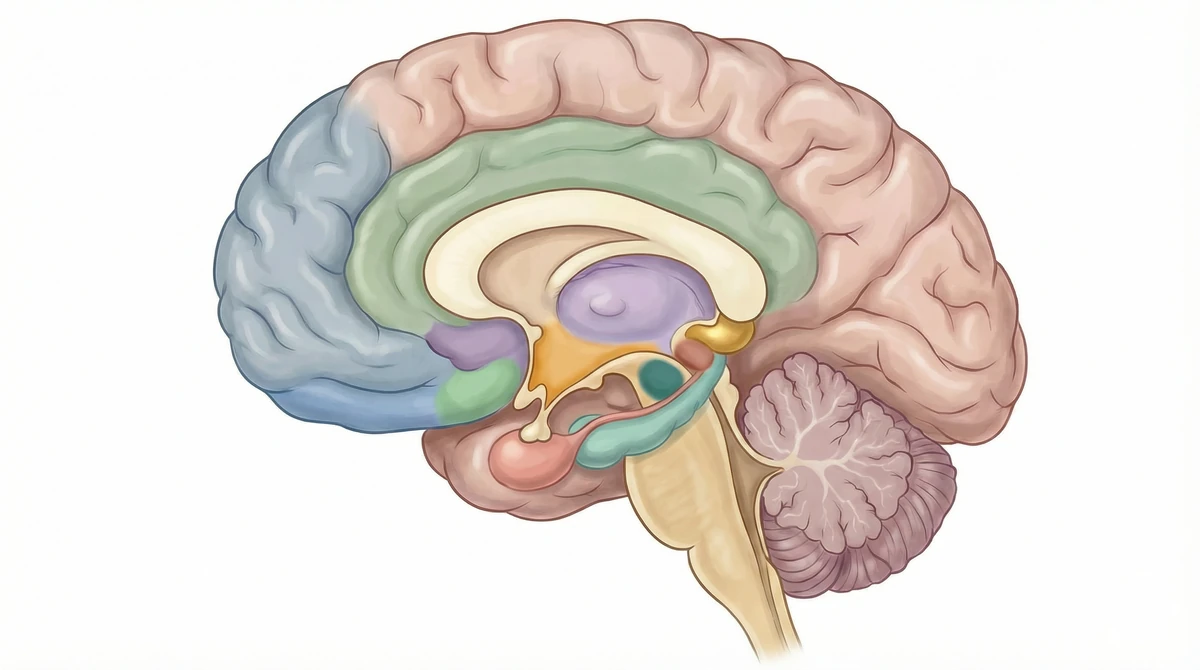
Neuroscience
Understanding the brain regions involved in structural dissociation helps clinicians appreciate how trauma creates neurological divisions in the personality.
Brain Regions Involved in Structural Dissociation
Click on any brain region to explore how structural dissociation manifests neurologically.
Session Language
Assessing Dissociation
Accurate assessment of dissociative symptoms is essential in understanding the extent of fragmentation and tailoring treatment for clients with complex trauma. Clinicians can begin with screening tools to gauge the presence of dissociative symptoms and follow up with in-depth diagnostic assessments when indicated.
Screening Tools
Advanced Diagnostic Tools
If the DES2 indicates significant dissociation, clinicians may use a structured diagnostic tool to gain a fuller understanding of the client's dissociative profile. While both the DDIS and MID provide valuable information, only one tool needs to be selected based on clinical needs.
Real-Time Monitoring of Dissociative States
Clinical Note
Always assess for dissociation before beginning trauma processing. Unrecognized dissociation is a primary reason for treatment failure and can lead to destabilization if processing proceeds without adequate preparation.
Dissociative Experiences Scale II (DES-II)
The severity and duration of a client's traumatic events and/or environments is directly proportional to the amount of time that should be allotted for treatment. The more highly dissociative a client is, the more time the clinician will need to spend in the stabilization phase of therapy.
When dissociation affects a client's orientation to the present, assess alertness and orientation before deciding how to proceed. AAO×3 (Awake, Alert, and Oriented to person, place, and time) provides a concrete check.
If Dissociation Scores Are High
When DES-II scores are elevated (30+), further diagnostic assessment is essential before beginning trauma processing. Two instruments are recommended:
DDIS
Dissociative Disorders Interview Schedule
Structured clinical interview by Dr. Colin Ross for diagnosing dissociative disorders. Provides systematic assessment across all DSM dissociative disorder criteria.
MID
Multidimensional Inventory of Dissociation
218-item comprehensive assessment by Paul F. Dell, Ph.D. that differentiates dissociative disorders from other conditions. Free for trained mental health professionals.
5 Pre-Session Screenings (8 PDFs)
ITQ (Trauma), Adult Attachment (AAQ), DES-II Dissociation, Sensitivity Questionnaire, and Columbia Suicide Screening ~ client & clinician versions
How Each Modality Addresses Structural Dissociation
Further Reading
For a more in-depth understanding of dissociation, dissociative disorders, and structural dissociation, the following books are highly recommended:
Brand, B. L., Schielke, H., Schiavone, F., & Lanius, R. A. (2022).Finding Solid Ground: Overcoming Obstacles in Trauma Treatment. This book offers evidence-informed strategies for stabilizing and treating complex trauma and dissociation.
Schielke, H., Brand, B. L., & Lanius, R. A. (2022).The Finding Solid Ground Program Workbook: Overcoming Obstacles in Trauma Recovery. A companion workbook providing practical exercises for trauma recovery.
Brand, B. L. (2023).The Concise Guide to the Assessment and Treatment of Trauma-Related Dissociation. A comprehensive guide on assessing and treating trauma-related dissociation.
Fisher, J. (2017).Healing the Fragmented Selves of Trauma Survivors: Overcoming Internal Self-Alienation. This book explores therapeutic techniques for integrating fragmented self-states in trauma survivors.
Lanius, R. A., Paulsen, S., & Corrigan, F. M. (2014).Neurobiology and Treatment of Traumatic Dissociation: Towards an Embodied Self. Springer Publishing. This text focuses on the neurobiology of dissociation and its treatment.
Steele, K., Boon, S., & van der Hart, O. (2016).Treating Trauma-Related Dissociation: A Practical, Integrative Approach. This book provides an integrative approach to treating dissociation in trauma patients.
Boon, S., Steele, K., & van der Hart, O. (2011).Coping with Trauma-Related Dissociation: Skills Training for Patients and Therapists. A manual offering skills training for managing dissociation.
van der Hart, O., Nijenhuis, E. R. S., & Steele, K. (2006).The Haunted Self: Structural Dissociation and the Treatment of Chronic Traumatization. This foundational text discusses structural dissociation and its treatment.
Ogden, P., & Minton, K. (2006).Trauma and the Body: A Sensorimotor Approach to Psychotherapy. This book integrates body-based approaches into trauma therapy.
Resources & Downloads
Quick Reference Card
2-page clinical guide
Window of Tolerance
Related foundational concept
Van der Hart, O., Nijenhuis, E.R.S., & Steele, K. (2006). The Haunted Self: Structural Dissociation and the Treatment of Chronic Traumatization. Norton.
Steele, K., Boon, S., & Van der Hart, O. (2017). Treating Trauma-Related Dissociation: A Practical, Integrative Approach. Norton.
Nijenhuis, E.R.S. (2015). The Trinity of Trauma: Ignorance, Fragility, and Control. Vandenhoeck & Ruprecht.